How to Get#q=where Can I Get My Medical Card Near Me
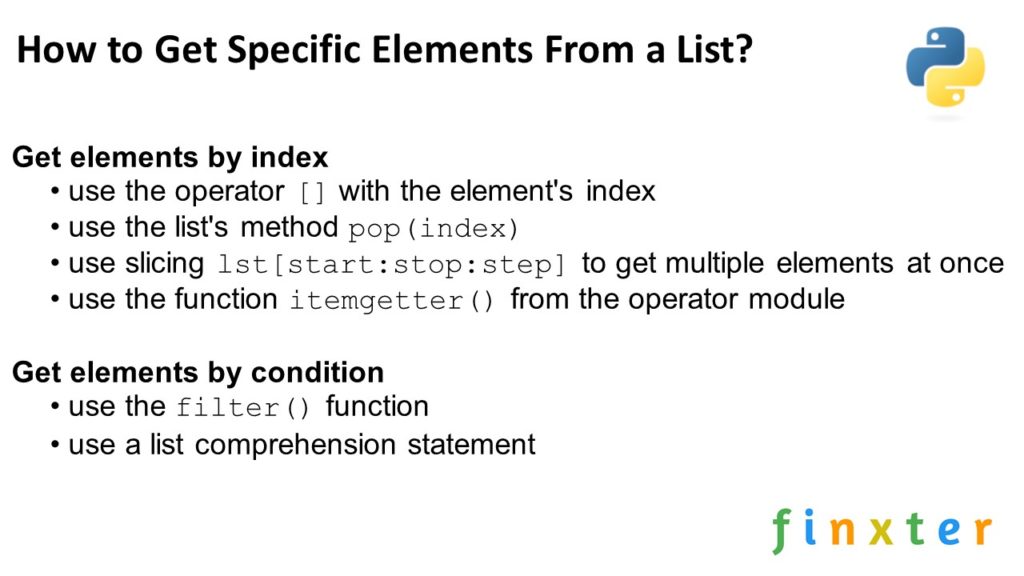
Quick Article Summary to get a specific element from a list:
- Become elements by index
- use the operator
[]with the element'southward index - use the list's method
pop(index) - use slicing
lst[start:stop:step]to get several elements at once - utilise the role
itemgetter()from the operator module
- use the operator
- Get elements past status
- use the
filter()function - use a list comprehension argument
- use the
Python lists surely belong to the must-knows for any Python developer. They allow y'all to store, iterate and manipulate data effectively and with very little code. However, there is another important list topic: How to access list items?
In the outset part of this commodity y'all will larn all possible ways how to get specific elements from a list. In the second role you volition see how to apply the theory to practical questions.
Permit'southward take every bit instance a listing ps containing points from the 2nd infinite. If you need more background on lists, I desire to recommend yous this article.
Become Specific Elements from Listing past Index
To access whatever item in a listing employ the brackets operator with the index of the particular you desire to recollect. E.g. if we want to access the betoken (4, v) from our list ps nosotros write:
# list of points from the second space ps = [(2, four), (-i, 7), (four, 5), (three, -4), (-1, -five)] point = ps[2]
The indices beginning at 0, therefore the 3rd chemical element'south index is 2. In Python it is also possible to count from dorsum to forepart using negative indices.
This is very handy, specially for retrieving the last or second final element.
The alphabetize of a listing'due south final element is -i, the index of the second last is -2 and and then on.
Try information technology out:
Get Specific Elements from List using pop()
If you lot want to access and remove an item from a list, call the popular() method with
the index of the element. If you don't pass a value for the index, the pop() method
returns and removes the terminal element from the listing.
This is how you get and remove the detail (four, 5) using the pop() method:
# listing of points from the second space ps = [(2, four), (-1, 7), (4, 5), (iii, -4), (-1, -5)] item = ps.pop(ii) print(ps) # [(2, 4), (-i, vii), (3, -iv), (-one, -5)]
Now, the variable item has the value (four, five).
Get Specific Elements from Listing with Slicing
To get a continuous range of elements from a listing, utilise slicing.
Slicing too uses the brackets operator with a showtime and terminate index.
As code it looks as follows:
ps = [(2, 4), (-ane, vii), (4, 5), (3, -4), (-1, -5)] items = ps[2:4]
where the first number before the colon (:) is the outset index and the second number,
after the colon, is the finish index. The kickoff index is included, the end alphabetize is excluded.
In our example items = ps[2:iv] the start index is 2, the end alphabetize is iv.
Since the start index is included, we get the elements at indices 2 and iii.
The stop index is non included, therefore the element at index 4 is non included.
Thus, the value of the variable items will be [(4, 5), (three, -4)]
With slicing you can apply a 3rd parameter step to become items in a range with
regular distances. Read more almost slicing in our detailed article.
itemgetter()
The module operator provides the itemgetter function which allows you
to access multiple elements from a listing simultaniously.
Here is the code:
from operator import itemgetter ps = [(two, iv), (-one, 7), (four, 5), (3, -iv), (-i, -5)] got = itemgetter(0, 2, 3)(ps)
After this line the variable got contains the items from the indices 0, two, three equally tuple.
Become Elements from List using filter()
In the solutions we discussed previously, nosotros used indices to get elements from a
list. Some other possibility is to become elements from a list by a certain condition.
For instance, we could desire to become all elements from the listing ps that accept a distance
of half-dozen.0 or more from (0, 0). Since we don't know the indices of those elements, we
can't utilise a solution that requires the indices. Python provides a built-in role called filter().
The filter() method requires two parameters:
a function wich returns Truthful/False and an iterable.
The filter() office applies the function to each element from the iterable and
keeps just the elements for which the function returned True.
Using the filter() function we can go all elements with a distance greater than
6.0 from (0, 0) like this:
def dist(10): return (x[0] ** two + x[one] ** 2) ** 0.5 ps = [(ii, 4), (-1, 7), (4, 5), (3, -four), (-1, -5)] filtered = list(filter(lambda x: dist(x) > vi.0, ps))
As you tin see in the code, the result of the filter() function has to be converted
back to a list.
List Comprehension with Condition
Need background on listing comprehension? Read more here.
Another way to get all elements from a list which satisfy a certain condition is a
listing comprehension. The algorithm behind the list comprehension is chosen Linear Search.
Linear Search iterates over the input once and appends all elements that satisfy the
condition to a new list.
In our example where we wanted to get all points from the list ps whose distance from
(0, 0) is larger than vi.0 nosotros need the post-obit code:
def dist(x): return (x[0] ** 2 + x[1] ** 2) ** 0.5 ps = [(two, four), (-one, 7), (4, v), (3, -4), (-ane, -five)] filtered = [p for p in ps if dist(p) > 6.0]
Try it yourself:
Applications
In this section we desire to widen the scope a chip and see how we can apply the
solutions presented above. Therefore we chose some common issues.
Get Specific Indices from List
To get all the indices of a subset of items which satisfy a certain condition,
apply a list comprehenion:
def dist(10): return (x[0] ** 2 + x[one] ** ii) ** 0.5 ps = [(2, 4), (-one, 7), (4, v), (3, -4), (-1, -5)] filtered = [idx for idx, p in enumerate(ps) if dist(p) > 6.0]
Become Specific Lines from File
Suppose yous want to get all comments from a code file.
Again, I suggest to utilize a listing comprehension and for analyzing each line a regular expression.
import re pattern = r'^#.*$' comments = [line for line in open('code.py') if re.match(design, line)] If you want to know more about reading lines from a file, this commodity might exist for you.
Get Specific Role of String
To go a specific function of a string or substring, use slicing.
For example, become the substring from 3 to nine from the string 'Python is absurd!'.
s = 'Python is absurd!' substring = s[3:ten]
Go Specific Keys from Dict
Even though this topic might be more in the scope of dictionaries, I'd like to mention
that by converting a lexicon to a list, yous get a list of the dictionary'due south keys.
And now, nosotros are back to the topic of getting specific elements from a list.
For more advanced problems, use the dicionary method items(). For example to recollect all
keys whose value is a vowel:
d = {0:'a', ane:'b', ii:'c', 3:'d', four:'e'} vowels = [key for key, particular in d.items() if item in 'aeiou'] Larn everything about Python dictionaries here!
Determination
If you want to get specific items from a list in Python you take several possibilities to do so.
You tin group these solutions into 2 groups:
- Become elements by index
- employ the operator [] with the element's index
- use the list'southward method pop(index)
- use slicing (lst[start:stop:stride]) to become several elements at once
- use the function itemgetter() from the operator module
- Get elements by status
- employ the filter() function
- use a list comprehension
In any instance it is of import for any proficient Python programmer to master those
different solutions.
Source: https://blog.finxter.com/how-to-get-specific-elements-from-a-list/
Belum ada Komentar untuk "How to Get#q=where Can I Get My Medical Card Near Me"
Posting Komentar